Mostrando entradas con la etiqueta Deadlines. Mostrar todas las entradas

martes, 25 de noviembre de 2014

The Doctoral Thesis - PhD

Today's main topic has been the Doctoral Thesis but also research in general. We have discussed what might be your underlying reasons to embark in doing a PhD as well as which are the important points to consider when making this decision. Whatever the motivation or driving forces you may have, we can only but encourage you to pursue this fascinating and enriching experience. Below you have some videos to illustrate the topic both from a realistic but also humorous point of view.


Last but not least we have been talking about the final exam. As promised in the following link entitled Consejos para el ESTUDIO de la asignatura you can find some useful tips in Spanish on how to study the subject "Introduction to Research".

The final exam will start at 11.30 a.m. on December 19th, 2014 in rooms 3A, 3C and 3E of the Med School.
We wish you all the best and hope that you pass the examinations with flying colours!

martes, 14 de octubre de 2014

Scientific Writing


Today we have addressed the topic of how to present data in written form, focusing mainly on writing papers for biomedical journals. Why is writing important in science? Scientists need to communicate their findings and this is usually achieved via publishing their work in scientific journals. Thus, a critical aspect of the scientific process is to share your information and experience with the scientific community. Reporting your new results in biomedical journals is a quick way to disseminate the information to the specialized community contributing to increase the knowledge within a discipline as well as to help others interpret their own results.


Types of articles

We have mentioned
in class the different types of articles and their main characteristics. While most articles published are original research papers, there are also reviews, editorials, commentaries, perspectives, case reports or letters to the editor, among others.


Fundamental style considerations

In the
International Committee of Medical Journal Editors - ICMJE) you can find the Uniform Requirements for Manuscripts. Most biomedical journals have their own format, structure and writing styles. Therefore, it is important that you are familiar with the Instructions for Authors of the specific journal you aim to submit your manuscript.

Your text should conform to the conventions of standard written English (sentence form, grammar, spelling, etc.). Structure your sentences carefully using the basic division into subject, verb, and complement. In addition, the structure of the sentence will convey emphasis, draw attention to the most important part at the same time as help readers to interpret your meaning correctly. Moreover, you should structure your sentences and paragraphs to flow, conferring your article cohesion and coherence.
 
Your ideas will have little impact, no matter how good the research is, if they are not communicated effectively!

Keep in mind that scientific terminology has precise meaning. Thus, be certain you select your words correctly and adequately; write clearly and concisely. Writing and thinking are very closely linked, "fuzzy writing reflects fuzzy thinking". When people have difficulties in translating their ideas into words, it generally reflects that they may not be fully aware of what they want to transmit.
  • Adapt to the special requirements of your selected audience, journal and type of article.
  • Be precise and accurate: Scientific terminology carries specific meaning; learn to use it appropriately and consistently. In fact, it takes a deeper understanding to explain a complex topic simply and succinctly. 
  • Be clear and concise: Write briefly and to the point. Say what you mean simply and clearly avoiding embellishment with unnecessary words or phrases. Brevity is very important. Do not use colloquial speech or slang; do not use contractions like for example "don't" or "isn't".
"Brevity is the soul of wit" (W. Shakespeare)

Considerations for the preparation of a research article

One of the initial considerations is to choose the appropriate readership for your article. Usually you will be writing to your peers. Knowing your audience will help you to decide what information to include. Obviously, you write a very different article for a highly specialized, technical, disciplinary journal as opposed to a more general publication that covers a broad range of disciplines.  Another relevant aspect to take into account is the impact factor of the journal. 

The first step in the process of writing is to order and organize the information you wish to present. Another critical point when preparing your first draft is to decide the authors and their specific order. The choice of a good title is also extraordinarily important; it should be informative at the same time as attractive and objective. Some people work well from an outline, others do not. Whatever system you follow, be aware that scientific writing requires special attention to order and organization. Because the paper will be divided into sections, you need to know what information will go into each.
The following video very nicely summarizes the main sections of an article and their content.


  • You need to know the different types of articles (original research papers, reviews, editorials, commentaries, perspectives, case reports and letters to the editor, among others) together with their main characteristics and usefulness.

  • In addition, you have to be familiarized with the main sections of a research article, how to structure and develop them in order to communicate effectively. 


jueves, 11 de septiembre de 2014

Types of research


Clinical trials

Clinical trials are sets of tests in medical research that generate information on health interventions (e.g., drugs, diets, diagnostics, devices, therapy protocols).

Clinical trials often involve patients with specific health conditions. In early phases, participants are healthy volunteers who receive financial incentives for their inconvenience. In coordination with a panel of expert investigators, the sponsor decides what to compare the new agent with (one or more existing treatments or a placebo), and what kind of patients might benefit from the medication or device.
During the clinical trial, the investigators: recruit patients with the predetermined characteristics, administer the treatment(s), and collect data on the patients' health for a defined time period. These patients are volunteers and they are not paid for participating in clinical trials. 

Classification of clinical trials can be done by the way the researchers behave:
- In an observational study, the investigators observe the subjects and measure their outcomes.
- In an interventional study, the investigators give the research subjects a particular treatment (pharmacological, dietary or surgical). Usually, they compare the treated subjects to subjects who receive no treatment or standard treatment. Then the researchers measure how the subjects' health changes.

Taking into account their purpose five different types of trials can be organized:
- Prevention trials look for better ways to prevent disease in people who have never had the disease or to prevent a disease from returning. These approaches may include medicines, vitamins, vaccines, minerals, or lifestyle changes.
- Screening trials test the best way to detect certain diseases or health conditions.
- Diagnostic trials are conducted to find better tests or procedures for diagnosing a particular disease or condition.
- Treatment trials test experimental treatments, new combinations of drugs, or new approaches to surgery or radiation therapy.
- Quality of life trials (supportive care trials) explore ways to improve comfort and the quality of life for individuals with a chronic illness.
- Compassionate use trials provide partially tested, unapproved therapeutics to a small number of patients who have no other realistic options. Usually, this involves a disease for which no effective therapy exists, or a patient who has already attempted and failed all other standard treatments and whose health is so poor, he does not qualify for participation in randomized clinical trials.

The following videos show the importance of randomization and blinding.


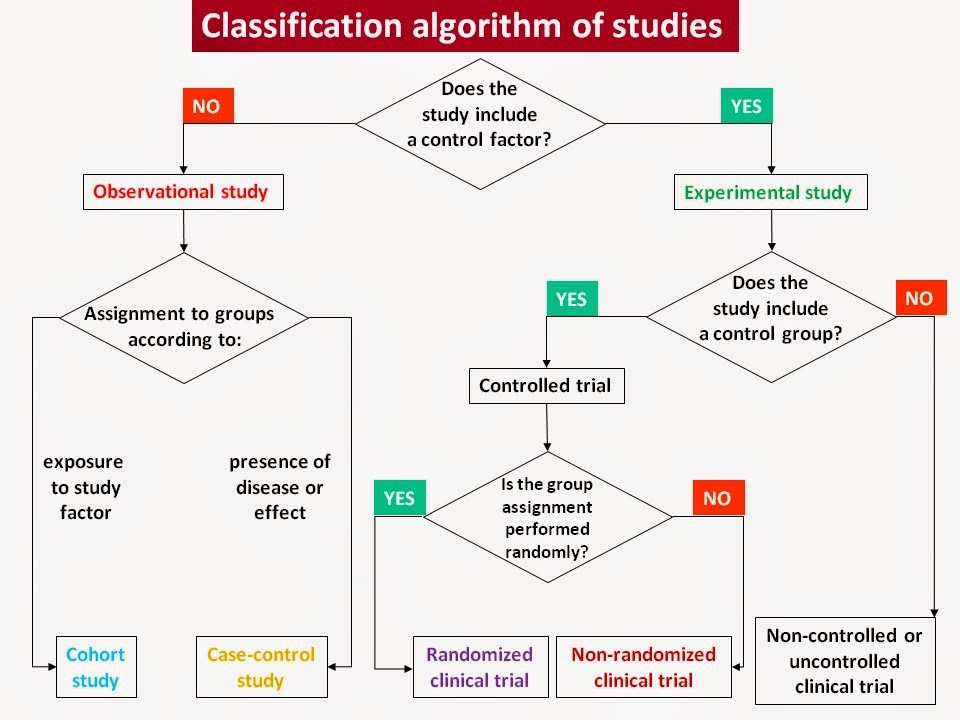
The classification algorithm shown below can help you to identify the main types of clinical trials being carried out by researchers.

Translational research

The traditional categorization of research identifies two main categories: basic research (also termed fundamental or pure research) and applied research. While basic research often leads to breakthroughs or paradigm-shifts in practice, it usually takes a long time to be applied in any practical context. On the contrary, applied biomedical investigation often represents an incremental improvement to current knowledge rather than a radical breakthrough, however, it has the advantage of exerting a potential direct impact on clinical practice in a relatively short time period. As mentioned by Albani & Prakken in their very comprehensive article published in the 2009 September issue of Nature Medicine, translational medicine encompasses the continuum of activities that extend from the conception of an idea to advanced clinical testing and, ultimately, to the development of a new medical technology or drug. Translational research refers to making findings from basic science useful for practical applications that improve human health and well-being. With a focus on multidisciplinary collaboration, translational research aims to move “from bench to bedside” or from laboratory experiments through clinical trials to point-of-care patient applications. However, translational research is bidirectional and also encompasses “from bedside to bench” approaches.

Compartmentalization within science together with the cultural separation between different scientific fields makes it difficult to establish the multidisciplinary teams that are necessary to be successful in translational research. Additional challenges for translational research arise in the traditional roadblocks encountered in academia, industry and government to successfully move an idea from its conceptual stage to early clinical development and final application. To flourish, translational research requires a knowledge-driven system that establishes a feedback loop to accelerate the translation of data into knowledge whereby the complex and underlying causes and outcomes of disease can be unravelled, to design either effective prevention processes or early detection and personalized treatment strategies. Thus, translational research entails two distinct domains, namely the enterprise of translating knowledge from the basic sciences into the development of new treatments at the same time as translating the findings from clinical trials into everyday practice.


  • Study the different classification possibilities of research studies together with their main characteristics, advantages and disadvantages.
  • This information will enable you to decide which is the most appropriate type of research in each case.
  • You need to know and understand what "translational research" means. 

Go to ADI to see the assignment of topics for the team work!


martes, 9 de septiembre de 2014

The scientific method

We have conducted a survey asking who, in your opinion, was the greatest scientist in history. These are the exact figures obtained via the clickers’ responses:


Although the question is subjective to some degree, 40% of the class matches the thinking of the majority of the Scientific Community. Surprisingly, a higher percentage (41%) states that Galileo was the most important scientist. Although Einstein (voted by 15%) has been considered the greatest scientist of the twentieth century, the Scientific Community identifies Isaac Newton as the most relevant scientist of all times.

The scientific method can be defined as the sequence of steps pre-established by a discipline in order to achieve valid knowledge through reliable instruments. In other words, the scientific method consists of a series of steps that we take to improve our knowledge in a reliable manner. It is described in an "informal" way in this video:


Chemistry music video on the steps of the Scientific Method. All music and lyrics copyright 2005, Mark Rosengarten. All rights reserved.


martes, 2 de septiembre de 2014

Getting started

Classroom 14 was packed full!

First of all, we have introduced ourselves... We wanted you to put the face to the name of the teachers that will guide you through the diverse topics of "Introduction to Research" during this semester.


Cartoon of the "Intro teachers" (Note: Andoni in the bottom right of the cartoon has been replaced by Leire this year) [Reproduced with permission of the artist (María Mouzo) and the owner of the cartoon (Ana Pérez); both students currently attending the 5th year at our Med School].

Making use of the "clickers" we have asked you about your interest on the subject - which is your opinion on the usefulness of this course, and whether you would like to devote your professional career exclusively to research or preferred to combine it with clinical work. Not surprisingly, approximately a third of you (36%) were unsure about the usefulness of this course. We hope to be able to raise your curiosity, interest and respect for science, as a whole, and for research, in particular, during the coming months by sharing with you the experience, passion and enthusiasm of many of the scientists that preceded us and paved the way to develop the knowledge that is being taught and applied nowadays. Also as expected, most of you (77%) would like to combine clinical work with research, while a minority (5%) expressed their interest of dedicating themselves exclusively to research. 

Subsequently, we have outlined why this subject is important to any medical student. What you are being taught and what you will learn throughout your medical career, and thereafter, is due to the research effort of many physicians and scientists that asked themselves questions in order to improve their knowlege to better help their patients.

We also want to "demystify" the image of the "boring researcher" working alone in his/her laboratory. In the following Lady Gaga parody videoclip you have a nice example of how funny scientists can be:


  • Research lies at the heart of all medical knowledge, activities and applications.


  • Attendance to practical sessions is mandatory.


  • There will be written short questions throughout the year that will have a 10% impact on your final score.


  • You will have to form a working group to prepare a topic to be presented in front of your classmates.


  • Additionally, as an individual you will have the chance to perform an optional or voluntary work consisting in a written essay on the book entitled "Bad Pharma" by Ben Goldacre.


  • It is important that you read the teaching guide of "Introduction to Research" to be aware of all the details of what is expected from you and how it will be evaluated.